
Background on the Kinde family
The Kinde family is a finance and industrial family from Gothenburg, Sweden. With roots dating back to the mid-19th century, the family has been the founder and owner of numerous companies in various industries, including finance, textiles, real estate, boat marina, leather manufacturing, flooring, and others. Over the years, the Kinde family has made significant contributions to the economic development of Gothenburg and beyond, through their entrepreneurial spirit and leadership in their respective industries.
A brief history of the family
The Kinde family has a rich history that is intertwined with several branches of prominent families in Gothenburg, Sweden. Through marriages with families such as Malm, Carlström, Calvert, Kjerulf, Wennerberg, Hall, Boye, Ewert, Leffler, Lundgren, Bauck, Damm, Oterdahl, von Sydow, Olbers, Waern, and others, the Kinde family is related to most of the older families in Gothenburg. The Kinde family is also associated with several prominent companies, including Gigab, AB Werner & Carlström, AB Calvert & Co., Bröderna Wennerbergs Handelsfirma, and Albert Fränkel & Co AB. AB Jakobsdals Kamgarnspinneri, along with AB Werner & Carlström and its subsidiaries, which together controlled 60% of the Swedish woolen yarn market for many years and was instrumental in establishing the modern wool industry in Sweden.
The Kinde family arrived in Gothenburg in the 1860s with Johannes Oscar Jacobson Kinde, who was born in 1848 and died in 1933. He descended from a family whose members served as priests or held the combined role of parish clerk and cantor (klockare) in Gällstad Parish, Kinds Härad in Västergötland, which had German origins. His father, Anders Jacobson, was the sixth generation in the family to serve as a parish clerk and cantor (klockare), organist and/or priest.
Johannes was the son of a parish clerk and cantor (klockare) and inherited a tradition that had shaped his family for nearly two centuries. For seven generations, beginning around 1680, the family lived at the same farm, Klockaregården. In an unbroken direct male line, successive generations held a multi-generational monopoly over the musical, educational and medical administration of the joint parish pastorate of Gällstad and Södra Säm in Kinds Härad, Älvsborgs Län—the region from which the surname Kinde derives. In rural Västergötland, where musical literacy and the ability to read scores were exceptionally rare, the office of parish clerk and cantor (klockare) functioned as a specialised hereditary profession passed from father to son.
Johannes Oscar Jacobson Kinde
Johannes Oscar Jacobson Kinde (J O Jacobson Kinde) was a prominent figure in the Swedish financial industry. He began his career as an accountant in 1866 at Ferd. Lundqvist Department Store in Gothenburg (now Nordiska Kompaniet NK) and received education at Gothenburg Handelsinstitut, where he later served as both a teacher and headmaster. He had several half-siblings, including Claes who was a priest ( and married to Eva Charlotta Kjerulf whose children and grandchildren are the last to bear the name Kjerulf in Sweden) and Jacob who founded Norra Kinds Sparbank. His half-brother Carl Johan emigrated to the United States and founded the town of Kinde, Michigan among other things.
In 1869, J O Jacobson Kinde co-founded Göteborgs Intecknings och Garanti AB (Gigab), Sweden’s second mortgage lending institution for real estate (Stockholms Intecknings och Garanti AB, also founded in 1869 a few months earlier, was the first). He served as the main owner, chairman, and CEO of the company from the early 1870s until 1913, when it merged with Göteborgs Bank. During this time, Gigab played a significant role in financing the expansion of Gothenburg and its properties, with a balance sheet total of nearly SEK 2 billion and equity of over SEK 300 million (in today’s money value) by 1912. Gigab has undergone several ownership changes and is now part of Svenska Handelsbanken after the purchase of Stadshypotek in 1996.
J O Jacobson Kinde was a multifaceted individual with a diverse range of interests and responsibilities. He co-founded Änke- och Pensionskassan in Gothenburg (one of the first pension fund for orphans and widows in Sweden) and served as its chairman for 15 years. He held several positions on various boards, including chairman of AB Jakobsdals Kamgarnspinneri for 20 years, board member of Fastighets AB Commercia, and trustee/board member in several social institutions. He was a board member, treasurer, and auditor at Renströmska Bad and Tvättanstalten from 1879 to 1910, a member of the National Board of Public Education from 1881 to 1882, and held various other positions including deputy in the grant committee, auditor at Drätselkammaren, and board member of the Eduard Magnus Musik Foundation.
J O Jacobson Kinde was also a talented amateur musician, playing cello, and was involved in founding both the old and new concert halls in Gothenburg. He was a member of several organizations, including the Royal Bachelors Club, the Gothic Association, and St. Johanneslogen Salomon á trois Serru-res.
J O Jacobson Kinde received several titles of merit for his contributions both in Sweden and abroad, and was awarded the Knight of the Wasa Order (RWO) in 1903.
He married Anna Charlotta Carlström in 1877. Anna was the daughter of Coast Guard Master Olaus Carlström and a member of the minor noble Carlström family. Her mother, Ulrika Hammar, was from the old Gothenburg Hammar family with several generations of residency in Gothenburg. Anna was also the sister of Wilhelm Olof Carlström, who married Anna Fredholm, a family of wholesale merchants, shipowners, and shipyard owners in Stockholm. They also co-founded Allmänna Svenska Elektriska Aktiebolaget ASEA (now ABB) in the mid-19th century.
Wilhelm Olof Carlström co-founded AB Werner & Carlström in 1885 together with Gustaf Werner, which was one of Sweden’s leading textile groups during the 19th and 20th centuries, and was the owner of AB Göteborgs Kamgarnspinneri among other companies. Gustaf Carlström, the famous artist, was Wilhelm’s son, who married Irene Keiller in 1920. The Carlström family had strong ties to Särö, a renowned seaside resort near Gothenburg.
Wilhelm had another brother, Axel Leonard Carlström, who was a priest and the father of Dr. Claes Leonard Carlström. Claes was a pioneer in cancer therapy and radiology, known for his work at Gothenburg University after studying at Uppsala University. In 1948, he was awarded an RWO 1st degree and was also considered for a Nobel Prize in Medicine around that time. Gustaf’s sister, Ulla Margareta, married into the renowned Spanish banking family, Rodriguez Acosta, who founded the Banco de Granada and the Banco de Madrid, among other ventures. Today, all their children use the surname Rodriguez Acosta Carlström, including the famous artist Miguel Rodriguez Acosta Carlström.
J O Jacobson Kinde and Family
J O Jacobson Kinde and his wife had seven children, who were all originally named Jacobson Kinde, but after 1901 they only used the surname Kinde:
Anna Maria Jacobson Kinde
Anna Maria Jacobson Kinde was born in 1876 and passed away in the 1950s. She married Konsul Knut Littorin d.ä., born in 1860, who was a board director and partner of the Nobel brothers in their Russian Nobel company with significant interests in Baku’s oil resources and estate ownership at Bjertorp Castle in Västergötland. The castle was designed by Ferdinand Boberg. Littorin had to flee Moscow in 1917 and changed places with his coach driver, resulting in his survival, but the coach driver did not. Bjertorp became a haven for Russian refugees after the Revolution in Sweden and was referred to as the “Petroleum Palace” in the 1920s. Anna and Knut had five children: Edla Berhardina, Maria Nadeshda, Emanuel Waldemar, Knut Oskar, and Sven Holger Littorin.
Emma Carolina Jacobson Kinde
Born 1877 and died 1878
Anders Oscar Jacobson Kinde
Anders Oscar Jacobson Kinde, a director born in 1879 and passed away in 1966, was married to Betzy (Hilda Maria Elisabeth) Wennerberg. Betzy, born in 1882 and died in 1969, came from the prominent Gothenburg Wennerberg family, who had ties to the Leffler shipowner family. Her father, Anton Wennerberg (married to Maria Catarina Vilhelmina Almqvist), and her grandfather was Johan Antonious Wennerberg. Anders was the managing director of the Bröderna Wennerbergs trading company for many years. Anders was educated at Handelsinstitutet and had two children with Betzy, Sixten Oskar August Kinde (born 1905) and Betzy Lisa Kinde (born 1906).
Johan Olof Jacobson Kinde
Also educated at Handelsinstitutet, born 1881 and died 1975. Johan Kinde married Flora Helena Topsy Calvert in 1905. Flora was part of the Calvert family, a Scottish trading family that immigrated to Sweden in the early 1800s. With Nils Thenberg, Johan founded the banking company Thenberg & Kinde AB in 1913, now known as Thenberg & Kinde Fondkommission AB merged into Consensus AB. He served on the board of AB Calvert & Co and other companies and was involved in the development of the Stora Teatern in Gothenburg, where he sat on its board for many years. Johan was also a talented cellist and served on the board of Eugene Sundberg’s Quartet Society. He and Flora had five children, including Leif Kinde, who was the father of Johan Kinde, a famous musician in the Swedish band Lustans Lakejer. The other children were Bengt Johan Kinde, Stig Olof Kinde, Britt Kinde (married to David Reginald Brolin), and Ulla Kinde (married to Harald Nils Wennergren).
Elsa Wilhelmina Jacobson Kinde
Elsa Wilhelmina Jacobson Kinde, born in 1882 and passed away in the 1950s, was married to Albert Gustav Fränkel. Fränkel was the founder of Albert Fränkel & Co AB, a Gothenburg-based company active in the textiles industry since 1875. Fränkel was also a co-founder of Jönköpings Tändsticksaktiebolag, which later merged with Swedish Match. Elsa and Albert had three children together: Gösta Oscar Fränkel, Fredrik Bruno Fränkel, and Vera Fränkel who married Gunnar Steen. Today, Göran and Leif Steen manage Albert Fränkel & Co. AB.
Jacob Wilhelm Jacobson Kinde
Jacob Wilhelm Jacobson Kinde, born in 1884 and died in 1962, was educated at Handelsinstitutet and was a member of the Royal Bachelors Club in Gothenburg (number 1680). He was married twice: first to Ester Hildur Vollmers, whose father founded Vollmers Modebazaar in 1902, later merged with Meeths in 1910 (now part of Åhlens one of the largest department store chains in Sweden); and second to Gunhild Elisabeth Malm, born in 1893 and died in 1971, a talented pianist educated at the Berlin Conservatory of Music who played with the Gothenburg Symphony Orchestra during the 1920s.
Her father was Fredrik Hjalmar Wilhelm Malm (born 1857 and died 1931) of the old Gothenburg family Malm (and more about this family below) and mother was Alfhild Elisabeth Arfwidsson (born 1863 and died in the 1920s) of the old Gothenburg family Arfwidsson. One of her siblings Märtha Cecilia Arfwidsson, born 1869 and died 1947, was married to Major Fritz Teodor Valentin Beselin at Göta Artillery Regiment, born 1863 and died 1949, and another sister Hedvig Margaretha Arfwidsson, born 1860 and died 1921, was married to the wholesale merchant Olof Edward Melin, born 1858 and died 1930
Her sister Elin Alexandra Malm, born 1890 and died 1978, ran Aktiebolaget Kinde & Co. for many years and her sister Sigrid Maria Malm, born in 1887 and died in 1919, was married to Nils Gabriel Ramstedt. Their cousin was the author and poet Karin Boye.
Their brother Paul Wilhelm Malm, born 1900 and died in the 1970s, director and general- agent in Scandinavia for Phoenix Assurance in London as the Malm family had been since the late 18th century until the early 1960s first by Jonas Malm d.y., born 1745 and died 1808, and then by six generations of the same family. Jonas Malm d.y. was married to first with Maria Kullman and then with Catarina Charlotta Eugenia Grabien whose father was Joachim Grabien, born 1723 and died 1795, wholesale merchant in Stockholm, and mother was Maria Juliana Törngren, born 1731 and died 1807. Her brother was Martin Törngren, born 1735 in Stockholm, died 1830, co-founder and director of the Swedish East India Company and owner of Råda manor and was related to Sir William Chambers.
Jonas Malm d.y. was one of the people who founded the Royal Bachelors Club (RBS) in Gothenburg in 1769. His membership number was 27. People from the Malm family have been members of this club since then for every generation until today with Jonas Peter Wilhelm Malm born 1941, father to Jonas Malm and Paula Malm was married to Annika Warberg. His sister Britt Marie Malm was married to Professor Erik von Sydow with three children Thomas von Sydow, Håkan von Sydow and Marie von Sydow. Through this connection and others in earlier marriages in the Malm family, the family is related to the late actor Max von Sydow.
Jonas Malm d.ä., (Jonas Malm dy’s father), (born 1706 and died 1783, 77 years old) began his career as an auscultant at the naval office in Karlskrona in 1726. He was for the next few years a clerk on a ship in convoy traffic for Spain and Portugal. In 1729, Jonas Malm came to Gothenburg as an auscultant in the Admiralty Office, and in 1730 he became a clerk at Bohuslän’s first rotating company. In 1734 he became a building and materials clerk at the Admiralty shipyard in Gothenburg, and in 1749 he advanced to treasurer and master of provisions at the Admiralty there. He was father to Alexander Malm (1748–1801), who enrolled at Uppsala University in 1767. He became a consistory notary in Gothenburg in 1775 and continued his career there. He became a high school lecturer in 1778, a lecturer in Greek in 1779, a second theological lecturer in 1785 and a first theological lecturer in 1795. Alexander Malm received the title of professor in 1794 and became a theologian in 1800. He was a member of parliament in 1789.
Jonas Malm d.ä’s son the wholesale merchant and shipowner Jonas Malm d.y. (1745–1808), was from 1794 one of Trollhätte Kanal’s auditors and 1799–1805 a member of the City Council of Burgers in Gothenburg. He was one of the five Gothenburg merchants who in 1797 took the initiative to set up a new discount bank in Gothenburg for the discounting of national debt notes (the first privately owned commercial bank in Sweden).
In 1799 he bought the the manor Kvibergsnäs near Gothenburg. He was also the director of the Swedish East India Company (third organisation). The death estate register after him shows that he also owned salteries and potteries at Älvsborg Fortress and in the Marstrand archipelago, and that he had trade connections with Copenhagen, Elsinore, Hamburg, Amsterdam, Dunkirk, London, Plymouth, Cork, Guernsey, Le Havre, Petersburg, Barcelona, Livorno, Naples and Brazil. Jonas Malm d.y. was also a Konsul.
Jonas Malm d.y. was the father of the wholesale merchant Johan Niclas Malm (1775–1829) in Gothenburg was married to Maria Cornelia Damm (1779–1826) and was related to wholesale merchant families Hall, Sahlgren, Maule and other families. Her brother’s (Christian Wilhelm Damm 1782-1848) daughter Harriet Joanna Damm (1820-1892) was married to the city architect of Gothenburg Victor von Gegerfelt (1817-1915). One of their two sons Wilhelm von Gegerfelt (1844-1929) was a well-known Swedish artist.
Johan Niclas Malm as a Member of Parliament 1809–1810 together with his Gothenburg colleague Berndt Santesson, he took the initiative for the decision on business and trade freedom for women in Sweden. Niclas Malm was a member of the Gothenburg City Council of Burgers 1809–1815 and City Councilor 1824–1829 and at an unknown time received the title of Commerce Councilor. 1810–1818, he was one of Gothenburg’s directors in the Göta Canal Company’s discount. His sister Christina Elisabeth Malm was married with Christian Heinrich Ewert.
His son the wholesale merchant Fredric Malm (1811–1856), married to Hedvig Wilhelmina Ewert, in Gothenburg led from 1842 D. Carnegie & Co’s iron and wood products exports. As this part of the company’s re-organisation and this business area disposal in 1845, he continued to manage his own iron and wood export business and became one of the leaders in Gothenburg in this area. His son, a bureau director of the Ministry of Finance, Hugo Theodor Malm (1842–1902), is known as a friend since youth of Pontus Wikner (Carl Pontus Wikner was a famed Swedish lecturer in philosophy and professor of aesthetics in Oslo in the late 19th century). Hugo Malm’s son Fredrik Malm (1879–1962) was bureau chief at the Vattenfall Board 1920–1944.
Niclas Malm’s brother the wholesale merchant Sven Peter Malm (1779–1825) in Gothenburg was a member of parliament in 1812 and a member of the Gothenburg City Council of Burgers from 1816. Half-brother to them was the wholesale merchant Wilhelm Malm (1794– 1839), married to Sofia Charlotta Bauck (1800– 1840 whose brother was the composer Carl Wilhelm Bauck 1808–1887, and he was the father of the famous artist Jeanna Elisabeth Bauck, 1840–1926), and he was a member of the Gothenburg City Council of Burgers 1825–1829. The Bauck family came from Hamburg around 1810 and was related to among others to the historical Hamburg banking family Behrens.
His son Peter Wilhelm Malm (1825–1865), (married with Magdalena Lundgren whose sister Hilda Augusta Elenora Lundgren was married with Joachim Carl Eduard Boye (born in Hamburg and first managing director of Brand och Lifförsäkringsaktiebolag Svea who later merged with Skandia in 1960) who was the grandfather of Karin Boye) in Gothenburg and in 1856 became a partner to his aforementioned half-cousin Fredric Malm, whose company he took over in 1857 after his death. From 1863, this Wilhelm Malm was a member of the Gothenburg City Council of Burgers. His brother Johan Maximillian (Max) Fredrik Malm (1838–1886) led the same company for a long time, which from the beginning of the 1870s developed into a significant company with interests in Svartå mill in Närke and Älvsbacka mill in Värmland. From 1883, Max Malm was also a member of the Gothenburg City Council of Burgers. After his death, the company was run by his and his brothers’ widows with his brother’s son Fredric Hjalmar Wilhelm Malm (1857–1934) as one of the procurators. In 1893, the company had to suspend payments. Max Malm, whose widow remarried to the explorer Major Sten Edvard Gleerup, was father to the commercial councilor Nils Peter Malm (1880–1962).
Through the Malm family, this part of the family are direct descendants of the Dutch Golden Age artist Frans Hals.
Jacob Kinde founded together with Linus Höglund and his brother-in-law Knut Littorin d.ä. AB Jakobsdals Kamgarnspinneri in 1910 (where he was CEO from 1910 to the end of the 1950s and was the majority owner) which owned a majority stake in Färgeriaktiebolaget Levanten, AB Varuhuset Linopeters (original name Göteborgs Linoleum- Magasin Peters, Franzen & Co) around 1910 together with Joseph Peters, Örgryte Kemiska, the trading company Aktiebolaget Kinde & Co. around 1905 which became a limited company around 1914, Aktiebolaget Carl Alm’s Skomanufaktur together with his brother-in-law Albert Fränkel, Matfors Yllefabrik AB, Bohus Läderfabrik AB, partner in Göteborgs Stubbvedsaffär, shareholder in Nissafors Träkols factory, Danielsson & Co, one of the founders and board member Träindustri, Byggnadsföreningen Jakobsdal upa, AB Elektrokompaniet, Samuelsson & Stenberg, Nissans Träförädlings AB, and one of the founders and board member of AB Svensk Kraftlinoleum which merged with Forshaga Linoleumsfabrik (today Forbo-Forshaga), Kindes Båtvarv AB etc.
Jacob Kinde was also one of the founders of AB Axel Christiernsson’s factory in Nol near Gothenburg together with Herman Meeths and was a board member of Herman Meeths AB. He also had interests in Volvo and the Skandinaviska Banken (now SEB) and others. He also founded and owned a number of real estate companies, for example Fastighets AB Commercia, Fastighetsaktiebolaget Partillo in Gothenburg and Fastighets-AB Domkvarteret in Gothenburg and AB Skott in Stockholm together with Herman Meeths.
He also owned Gunviken Gård in Brottkärr/Amundön from the 1910s where he lived with his family until his death in 1962 which the family still owns but is now subject to property development. Jacob Kinde and Gunhild Malm had twin sons born in 1928, Kurt and Yngve.
Yngve Kinde was the managing director the Linopeters Department Store until the early 1990s when the company was sold and also developed Kindes Båtvarv AB. Yngve Kinde was married with Barbro Eklund whose faher was a director of Bröderna Kanold AB for many years. Yngve Kinde died in 2006. One of Yngve Kinde’s children, Peter Kinde, managed Kindes Båtvarv AB until the sale in 2006 and runs Peter Kinde AB and other companies today. His second child, Annika Kinde Andersson, manages Aktiebolaget Kinde & Co. today.
Kurt “George” Kinde (one of whose godparents was Herman Meeths), engineering studies at Göteborgs Tekniska Institut, educated at the Royal Academy of Fine Arts in San Fernando in Madrid and Visva-Bharati University in Santiniketan, West Bengal, India, a member of KRO, was a talented sailor, artist and lived/ travelled all over the world, died in Portugal in 2007 and buried in the English cemetery in Lisbon. He had five children. Kurt Kinde was first married with Ninni Enell (Ingrid Anna Svenborg Enell) 1931-2003 also an artist educated at Gothenburg Art School, formerly Hovedskous painting school, whose father Oscar Georg Enell 1898-1972 (Enell is a Swedish estate and mill owner family descended from Olof Olsson in Eneberga, Kuddby parish, Östergötland, who was the father of the bell ringer and organist in Kuddby, music director Olof Enell 1773-1864), educated at Chalmers University of Technology (Chalmers), was responsible for the development of Gothenburg tram system for many years and of which he was a bureau director.
Kurt Kinde’s second wife was Ulla Tobé, daughter of Member of Parliament Erik Tobé and Margareta Bråkenhielm and together had two daughters Rebecca Kinde and Gabriella Kinde.
His third wife was the Viscountess Irene Pereira Alves Duarte da Lima de Branco from Portugal. Through the last marriage, Kurt Kinde and his children got the right to use the name Pereira Alves as an addition to their last name, including the title.
Jakob Kinde, one of Kurt Kinde’s children with Ninni Enell, is a banker based in London. Previously married to Marianne Wylson, whose ancestor James Wylson founded the Architectural Association, he was educated at University College London and began his career at the merchant bank Samuel Montagu & Co. Jakob was also a Director of Kleinwort Benson and one of the founders of NewMedia Spark plc/Spark Ventures plc/Spark Venture Management, AllIPO plc and Libertas Capital Group plc.
In 2012, Jakob re-established Boustead & Co, originally founded in Singapore in 1828, along with Boustead Agriculture Limited/Green Earth Africa Limited. He established Amber Fusion Limited (Boustead Renewables) in 2017 and serves as its Chairman.
Jakob also founded the Noble Tree Foundation in 2003; the charity adopted that name in 2016 and provided housing for homeless and vulnerable people in the UK. Noble Tree Foundation is now in Creditors’ Voluntary Liquidation due to a dysfunctional UK housing market.
Jakob Kinde is a father to four adult children – Christian, Geraldine, Alexandra, and Daniel. His brother, Per Kinde, educated at Chalmers, worked for many years at ESAB and currently operates Kinde Consulting AB. Jakob’s sister, Maria Kinde, holds degrees from Oxford University and Uppsala University and has extensive experience in the field of phraseology at the EU in both Brussels and Luxembourg. Jakob’s half-sister Mia Enell lives in New York and is married to Nicholas Fries. They have a daughter, Gala. Mia is an artist and received her education from Nyckelvikskolan School of Art in Stockholm and École Nationale Supérieure des Beaux-Arts in Paris. Mia is the daughter of the renowned artist Wiking Svensson and her works can be viewed at www.miaenell.com.
Ninni Enell’s mother, Majlie Carola Henrietta Dimming (1896–1967), was the wife of Oscar Georg Enell and connected the Enell and Kinde descendants to an old Swedish military family. The Dimming family, also recorded as Demming, rose from the educated administrative circles of northern Sweden during the Stormaktstid, or Great Power Era. The earliest known patriarch, Sven Dimming, served as a local official in Västerbotten.
His son, Captain Sven Dimming, entered the officer corps and served in the Västerbotten, or Nederbotten, Regiment from about the 1630s to the 1670s. Around 1650 his commission brought him personligt frälse status, a form of untitled nobility granted to senior officers that carried tax privileges and the right to bear arms. With his wife, Catharina (Karin) Månsdotter, he served on Sweden’s eastern frontier in Finland during the Northern Wars.
The family’s standing grew through Major Lorenz Dimming, a senior field officer active from the 1670s to about 1715 who commanded Carlsten Fortress at Marstrand. His marriage to Maria von Campenhausen connected the Dimmings with a prominent noble house of Dutch origin whose members served as military engineers and administrators in Sweden’s Baltic provinces. The marriage placed the family within a wider European fortress and officer elite.
Lorenz’s son, Captain Sven Dimming the younger, became the most celebrated military figure in the line. As a captain and commandant at Nya Älvsborg Fortress during the Great Northern War, he commanded artillery batteries when Admiral Peter Tordenskjold’s Danish-Norwegian fleet bombarded the fortress in July 1719. The successful defence protected Gothenburg’s water approach. Members of such garrison families were traditionally buried at the fortress church or on nearby Kyrkogårdsholmen.
Major Lorentz Johan Dimming (1745–1817), a direct ancestor of Mia Enell and Per, Maria and Jakob Kinde, continued the tradition in the Skara and Gothenburg regions. He married Gieraruta Amalia von Kublanck of an old Pomeranian noble family, qualified as an artillery officer in 1771, and became Master of Ordnance and acting commandant of Carlsten Fortress before retiring in 1810. His son, Captain Carl Fredrik Dimming (1774–1801), served as commandant at Nya Älvsborg Fortress from 1799 until his early death.
Dimming heraldry expressed the family’s frälse standing. The principal arms featured a silver fleur-de-lis on a blue field, with an open steel helmet and blue-and-silver mantling. In Swedish heraldic tradition, the open visor marked noble or frälse status. Captain Sven Svensson Dimming of the Österbotten Regiment adopted a separate variant in 1689: a deer’s head before an anchor and twig, with three stalks of grain as the helmet ornament.
Other officers extended the family’s service across army and navy. Captain Erik Johan Dimming served in the Österbotten Regiment and died in 1710. Captain Anders Dimming, a veteran of the Tönningen campaign of 1713, married Dordina Ridderstolpe and linked the family to an influential noble administrative line. Anders Wilhelm Dimming (1726–1757) represented its naval branch as a captain-lieutenant aboard the brigantine Prins Gustaf.
As Sweden’s period of expansion ended, the Dimmings became part of Gothenburg’s civic and mercantile life. Marriages connected Maria Dimming to the Hummel family of district judges and Anna Catharina Dimming to the Kullman family of wholesalers and shipowners, ancestors linked through the Malm family to Per, Maria and Jakob Kinde. Family tradition recalls Dimminge Hus and the loss of an ancestral fortune, while later descendants Gustaf, Herman and Axel Dimming appeared in trade and maritime records. The artist Baengt Dimming (1919–2004) was also a member of the family.
Per Jonas Jacobson Kinde
Per Jonas Jacobson Kinde was born 1887 and died 1924. Estate owner and lived at Wrangelsholms Säteri in Västergötland. He was a very accomplished shot and sailor. Per Kinde participated for Sweden in the Olympics in Stockholm in 1912 and in Antwerp in 1920 where he participated in the Clay Pigeon team (Bronze medal), Deer single shot team (Fourth place), Clay pigeons individually and Deer single shot individually.
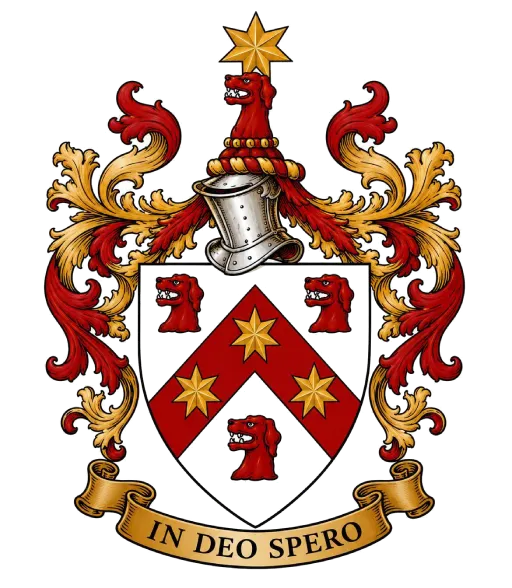
Kinde Family Coat of Arms
The coat of arms is officially registered number Kinde 569/99 in Skandinavisk Vapenrulla SVR.
Shield: In a field of silver a red chevron covered with three seven-pointed stars of gold and accompanied by three severed red dog-heads
Helmet cover: Red helmet cover lined with gold
Helmet ornament: A severed red dog's head crowned with a seven-pointed star of gold
Motto: In Deo Spero (Hope in God)
Sources
- Family Archives
- National Archives in Gothenburg
- National Archives
- Swedish Family Calendar
- Swedish State Calendar
- Swedish Biographical Lexicon
- Nobility Calendar
- GIGAB’s 100th-anniversary publication 1869–1969
- CRA Fredberg’s book The Old Gothenburg
- Wilhelm Berg
- Other historical documents
- Wikipedia