
Foundations
Origins and education
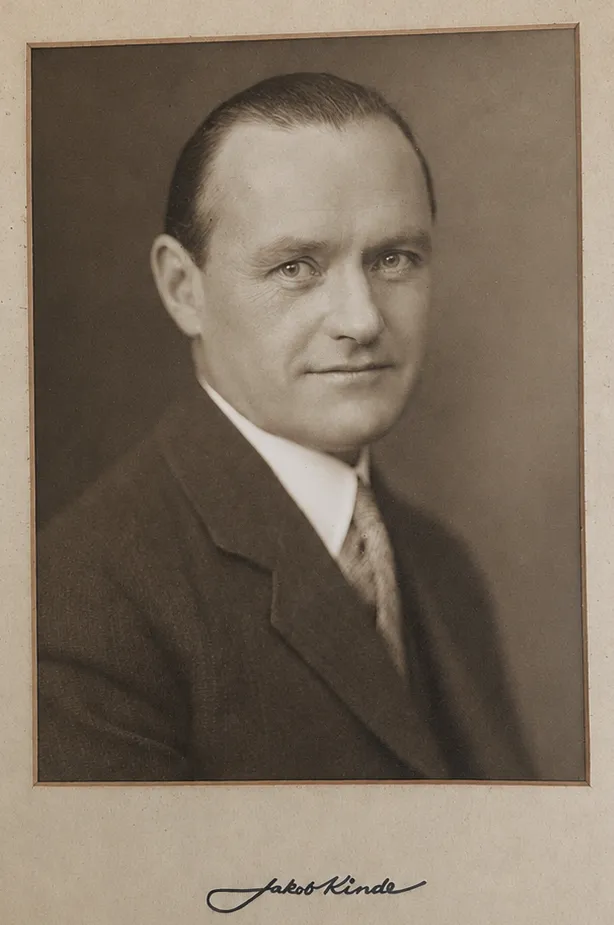
Jacob Wilhelm Jacobson Kinde was born in Gothenburg in 1884. His father, Johannes Oscar Jacobson Kinde, had arrived in the city during the 1860s and became an influential figure in education and finance. He lectured at and later led the Handelsinstitutet, took part in the early efforts to establish the Gothenburg School of Business, and helped found Göteborgs Intecknings och Garanti AB (GIGAB).
Jacob followed the commercial course set by his father and completed his own business education at the Handelsinstitutet. That training, combined with the family’s connections across banking, industry and trade, prepared him for a career that would extend far beyond Gothenburg.
1900–1905
The Russian petroleum years
Jacob’s sister Anna Maria married Knut Henrik Littorin, a director in the Nobel brothers’ petroleum company, Branobel. Littorin became closely associated with its important Moscow office and the wider commercial network linking Moscow with the oil fields and refineries of Baku.
Through this family connection, Jacob spent approximately five formative years in the Russian petroleum trade. Family records place his work within the Moscow and Baku network, where he gained first-hand experience of international commodities, industrial logistics and large-scale enterprise. He returned to Gothenburg amid the political upheaval of 1905, bringing that experience into his own business career.
Commerce and industry
Building an industrial group
In 1905, Jacob founded the private trading house Kinde & Co. The business became Aktiebolaget Kinde & Co in 1914 and developed into the family’s principal commercial and investment vehicle. Its early activities centred on industrial materials, including metal processing and the recovery of scrap for local shipyards and railways.
Jacob’s interests expanded rapidly across textiles, retail, flooring, chemicals, leather, timber, property and finance. Many ventures were built with relatives or people first known through Gothenburg’s sporting and commercial circles. Linus Höglund, for example, was both a bandy associate and a partner in AB Jakobsdals Kamgarnspinneri.
AB Jakobsdals Kamgarnspinneri
A major worsted-yarn spinning company founded in 1910 with Knut Littorin d.ä. and Linus Höglund. Jacob was majority owner and managing director until the late 1950s.
Kinde & Co and industrial materials
The trading house dealt in bulk industrial materials, including the processing and recycling of scrap metal for Gothenburg’s shipyards and railways.
Oilcloth and flooring
With Joseph Peters, Jacob operated an oilcloth factory at Rosenlundsgatan 4 and distributed flooring and household goods through Göteborgs Linoleum Magasin at Kungsportsplatsen 2.
Retail and Meeths
He served on the board of Herman Meeths AB. His first marriage to Ester Hildur Vollmers also connected him with Vollmers Modebazaar, founded in 1902 and merged with Meeths in 1910.
Manufacturing interests
His interests included Färgeriaktiebolaget Levanten, Örgryte Kemiska, Aktiebolaget Carl Alm’s Skomanufaktur, Matfors Yllefabrik, Bohus Läderfabrik and AB Svensk Kraftlinoleum.
Property, finance and infrastructure
He held interests in timber, charcoal, electrical and property companies; helped establish AB Axel Christiernsson’s factory in Nol; and maintained interests in Volvo and Skandinaviska Banken.
Beyond business
Sport and the sea
Sport was an important part of Jacob’s life and of the relationships through which Gothenburg business was conducted. He played competitive bandy, was active in lawn tennis and shooting, and is remembered in family records as a founding figure in the Gothenburg Lawn Tennis Club. He helped the sport move from private grass courts towards permanent indoor clay facilities at Ullevi and Mässhallen, and served in an official capacity during the 1923 Sveriges Idrottsspel.
Shooting also brought international distinction to the family. Jacob’s brother Per Kinde (1887–1924), a landowner in Valtorp, represented Sweden in sport shooting and won a bronze medal in the team trap event at the 1920 Antwerp Olympic Games.
On the water, Jacob continued a Kinde family association with the Göteborgs Kungliga Segelsällskap (GKSS) that reached back to his father’s generation. His twin sons inherited that maritime tradition, and his large motorboat was used to tow their small racing boats to regattas in the southern archipelago.
From the 1910s, Gunviken gård at Brottkärr and Amundön became the family home. The coastal property provided a base for the family’s sailing life and for Kindes Båtvarv AB, the boatyard whose site later developed into Amundö Marina.
A second generation at the helm
Kurt “George” Kinde’s competitive sailing
Kurt became an elite helmsman in Western Sweden’s competitive sailing circuits. As he moved into the larger boats he owned, he established a naming tradition: each carried the name Corona, followed by its number in sequence.
Mid-1940s
The apprenticeship
Kurt skippered the custom H. Hallberg-built wooden Stjärnbåten, hull no. 327, Slagfjädern, for GKSS. At the Särö Båtklubb Regatta on 4 August 1946, official timing records list a finish of 2:21:31. Jacob used his motorboat to tow Slagfjädern and Yngve’s sister hull, Lattjo II, into the archipelago for regattas including Kullaviksdagen.
1950s
The Dragon years
Moving into the International Dragon class, Kurt campaigned the 8.90-metre wooden racing keelboat no. 151, Corona, in GKSS match racing. The boat was later sold to the Swedish art critic, museum director and author Folke Edwards, who transferred its registry to Stockholm.
From 1963
The solo Finn campaign
Kurt also raced the physically demanding, single-handed Olympic Finn dinghy. His Elvstrøm Boats-built SWE 472 was registered as Corona VII and campaigned from Hovås across the waters of Askims Fjord.
Kurt’s performance across the Corona fleet culminated in his election to Göteborgs Yacht Club, an honour that placed him within Western Sweden’s established circle of competitive helmsmen.
Home and culture
Family and cultural life
Jacob married twice. His first wife was Ester Hildur Vollmers, whose father established Vollmers Modebazaar in 1902. The business merged with Meeths in 1910, reinforcing Jacob’s connection with one of Gothenburg’s leading department stores.
Music was already deeply rooted in the Kinde household. Jacob’s father, Johannes Oscar Jacobson Kinde, played the cello; Jacob played the violin; and his brother Johan was also a cellist. Johannes Oscar was a founding member of Eugène Sundbergs Kvartettsällskap, the chamber music society established in Gothenburg in 1884.
The society grew from a bequest by the wealthy merchant and amateur musician Eugène Sundberg. After his death in 1883, Sundberg left 10,000 kronor to establish a leading Gothenburg chamber music society modelled on Stockholm’s Mazerska Kvartettsällskapet. On 11 March 1884, exactly one year after his death, Johannes Oscar joined a small group of the city’s cultural leaders—including the composer Josef Czapek—to sign the bylaws and formally establish Eugène Sundbergs Kvartettsällskap, commonly known as Sundbergska.
His second wife, Gunhild Elisabeth Malm (1893–1971), brought exceptional cultural distinction to the household. In the early 1910s she left Sweden to train at Berlin’s renowned Klindworth-Scharwenka Conservatory, developing the technique and endurance demanded by the Romantic concert repertoire.
After returning to Sweden, Gunhild became a prominent concert pianist and appeared as a headline soloist with the Gothenburg Symphony Orchestra during its 1920s golden era. Her repertoire centred on the grand works of Frédéric Chopin, Johannes Brahms and Robert Schumann. The athletic intensity of those performances formed a cultural counterpart to the family’s competitive life on the water.
Jacob’s membership no. 1680 at Gothenburg’s Royal Bachelors’ Club belonged to this cultural and social world. The connection also reached into Gunhild’s family history: her ancestors were among the founders of the club in the eighteenth century.
Jacob and Gunhild’s twin sons, Yngve and Kurt, were born in 1928. Yngve entered the family businesses. Kurt became a professional artist and member of Konstnärernas Riksorganisation (KRO), training internationally at the Real Academia de Bellas Artes de San Fernando in Madrid and at Kala Bhavana, Visva-Bharati University’s college of fine arts in Santiniketan, West Bengal. Their contrasting careers carried forward the commercial, artistic and maritime strands of the household in which they had grown up.
1905 to the present
Continuity across generations
Jacob was Kinde & Co’s founder and first managing director. Gunhild’s sister Elin Alexandra Malm later served as a director and managed its operations for many years, helping to sustain the business through a period of industrial change.
Yngve Kinde subsequently led AB Kinde & Co and managed the Linopeters department store into the early 1990s. He also developed Kindes Båtvarv. The next generation continued along both lines: Peter Kinde managed the boatyard until its sale in 2006, while Annika Kinde Andersson became managing director of the Swedish company.
The commercial outlook established by Jacob also found an international expression through Kinde & Co Limited in the United Kingdom. Led by his grandson Jakob Kinde, the company continues the family’s investment and strategic advisory tradition in a modern setting.
A connected generation
The wider Kinde family
Jacob’s siblings reflected the family’s unusually broad involvement in Gothenburg’s industrial, financial, cultural and sporting life.
Anna Maria Jacobson Kinde
Married Knut Henrik Littorin, the director of Branobel’s Moscow office and Jacob’s early connection to the Russian petroleum trade.
Johan Olof Jacobson Kinde
A cellist and co-founder of the stockbroking firm Thenberg & Kinde AB in 1913; he also served on the boards of AB Calvert & Co and Stora Teatern.
Anders Oskar Jacobson Kinde
Married Hilda Betzy Maria Wennerberg and became involved in the Wennerberg family’s trading business.
Elsa Wilhelmina Jacobson Kinde
Married Albert Gustav Fränkel, linking the family with the Gothenburg textile house Albert Fränkel & Co AB.
Per Jonas Jacobson Kinde
A landowner in Valtorp, sailor and accomplished shot who won team trap bronze for Sweden at the 1920 Antwerp Olympic Games.
The twin sons
Business stewardship and an artistic life
Yngve Kinde
Yngve became managing director of AB Kinde & Co and of the Linopeters department store, which he led into the early 1990s. His work also helped transform the family boatyard into a modern marina business.
Kurt “George” Kinde
Kurt became a professional artist and member of KRO after studies in Madrid and at Visva-Bharati University in Santiniketan. In parallel, his long competitive sailing career took him from the Stjärnbåten Slagfjädern to the Dragon Corona and the Finn dinghy Corona VII.
Research
Sources and editorial note
This profile draws principally on the Kinde family archive. Public historical records have been used to corroborate selected business, Branobel and Olympic details. Where a detail rests chiefly on family testimony, the text identifies it as a family record.
- Kinde family archive and biographical notes
- Companies associated with the Kinde family
- Branobel History Project: Knut Littorin and the Moscow office (opens in a new tab)
- Svenska industrien 1924–1925: Kinde & Co oilcloth works (opens in a new tab)
- Swedish Olympic Committee: Per Kinde (opens in a new tab)
Continue the story